Wednesday, January 29, 2014
Intranasal vaccine protects mice against West Nile infection
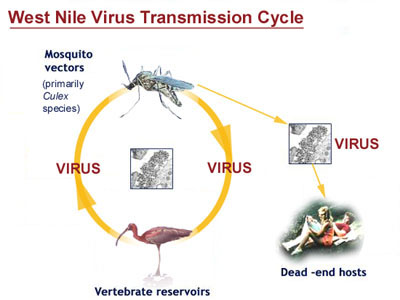
This article explains how researchers have developed a nasal vaccine formulation that provides protective immunity against the West Nile virus infection in mice after only two doses. The researchers explain how only 2 vaccine doses provide a protective anti-WNV immunity. WNV is a mosquito-borne virus that can cause febrile illness, encephalitis (inflammation of the brain) or meningitis (inflammation of the lining of the brain and spinal cord). Even though the virus has been known to have been the cause of severe human disease for decades, it only appeared in the US in 1999. It has spread across the country, causing a reported 2,374 cases of infection in people, including 114 deaths in 2013 alone. Even though a vaccine has been made available for horses, there is no vaccine available for humans. The vaccine that is being used for mice is being prepared by mixing the antigen for HBV (hepatitis B virus) and adjuvant compounds in a water based (saline) solution. Researchers are now planning future studies in rabbits in order to continue developing the intranasal West Nile Virus vaccine. Rabbits have a nasal cavity size that is close to the size of the human nasal cavity and therefore an ideal model to further develop needle-free intranasal vaccines. This article comes across clearly. Even though the virus has been around for awhile, I am just learning about this now. It is clear that this is a dangerous disease that can cause severe illness and that vaccines are being made in order to prevent this disease. The author clearly explains the symptoms of the disease and how researchers have vaccines for horses and have just made vaccines for rats. He also clearly explains that they plan to research vaccines for rabbits because they have the same size nasal cavity as humans, which would be a future model. The only concept that was unclear was how is it that we are just learning about this virus? It has been apparently around for decades and just appeared in the US in 1999. The government needs to let the people know about this so that they can take precautions against the virus and hopefully not get infected. This was clearly unbiased, and the author is just simply stating the achievement this team of researchers have made into making a vaccine for rats against the West Nile Virus

Subscribe to:
Post Comments (Atom)
This has proven to be some pretty awesome research in the way of diseases that need to be stopped in their tracks. With this new found discovery hopefully people can start treating this disease that has stricken countless people all over the world. I just wish that they would have developed this sooner, or given us more information on how not to get this horrible disease. i have definitely known about West Nile and actually had a scare myself a while back, it's very prevalent in all parts of the world, but the thought of a vaccine was definitely some good news. Which raises the question when will it be good enough for human use? That would definitely be something I would like to know before WN comes back again this summer. Also, does it have any kind of adverse effects that may be harmful to humans? It would be interesting to see if they do on rats and bunnies to see how much more research needs to be done on this.
ReplyDeletePersonally I had forgotten about this virus but I do recall when it was really popular a couple of years ago. I would've never thought that there would be that many deaths due to this virus last year. It sucks how this virus has been around for so long and they are barely getting a vaccine in effect. I would love to hear more about this vaccine and if it contains side effects
ReplyDeleteWe have a researcher in Biology at UNM, Dr. Bruce Hofkin, who is studying the prevalence of this virus in New Mexico.
ReplyDeleteBias alert: The virus was discovered in Uganda in 1937. My guess is that vaccines were not worked on for many years because the disease was prevalent in many poor countries and drug companies often go after higher profile, more profitable drug candidates.
There's a wonderful story about the discovery of WNV in New York in the book, Microbe, and I've put a copy on Ereserve.